FOCUS ON: THE RELUCTANT RADICAL

 THE RELUCTANT RADICAL posits documentary as an extension of activism. It creates from its opening scene an inexorable trajectory towards its climax: climate activist Ken Ward’s boldest direct action yet, in which he and a coordinated group of environmentalists shut down the TransMountain pipeline in 2016. As a result of this action, activists and documentarians alike are arrested and await trial. 

Ward’s narrative is framed by the sobriety of the case brought to the Skagit County Superior Court of Washington state. Defense attorney Ralph Hurvitz, representing Ward, asks the jury to consider the role of civil disobedience--not as a remote hagiography of founding fathers, but as a transformative force in the US today. That the jury, for the sake of privacy, remains anonymous and off-screen lends the documentary a certain urgency; as a viewer, you join the jury of Ward’s peers. TRR thus sharpens the self-consciousness of its viewership through its mode of address, posing the questions: Where do you stand? How do you do it?

Similarly, director Lindsey Grayzel locates the voices of the environmentalists as they are amplified in a bright sea of touch-screens. Here, the documentary filmmaker’s lens is not alone, but surrounded by auto-documentation meant for instantaneous publication on social media platforms. This is another aspect in which the radical’s action is intrinsically connected to the act’s mediation and portrayal. Such reflexivity prompts a host of questions: Does it create a sense of competition for the director? Or how does a director differentiate the intent of social media documentation from the intent of a feature film-in-progress?

Throughout the film, TRR develops the figure of the caretaker (or in Ward’s case, multiple figures): a figure in the activist’s life who may not participate directly in the protest, but whose role as a support agent is equally significant in activism’s equation. In the depiction of Ward’s persona, the human counterweight of the support figure offsets the classically tragic notion of the radical as a fundamentally individual and dissociative figure, while it also sheds light on the social expenses of direct action. Activists are not simply administrators of self-sacrifice; they tend to rely on a network of support in order to effect their political struggle.

When Ward contests the label of ‘radical’ toward the end of TRR, it is more than a show of sheepish humility. For him, the term seems too freighted for the activism he feels is necessary; here, Ward is calling for an asceticism of personal aesthetic. Here and elsewhere in Grayzel’s documentary, action and representation are not disparate but intricately connected, so much so that the act of mediation itself is a political choice, and the question of activism’s discursive reality remains: What do you think, and what will you make of it?

THE RELUCTANT RADICAL screened on Sunday, March 25, 2018 at 7:20pm

FILMMAKER SPOTLIGHT: Erika Cohn, Director of THE JUDGE

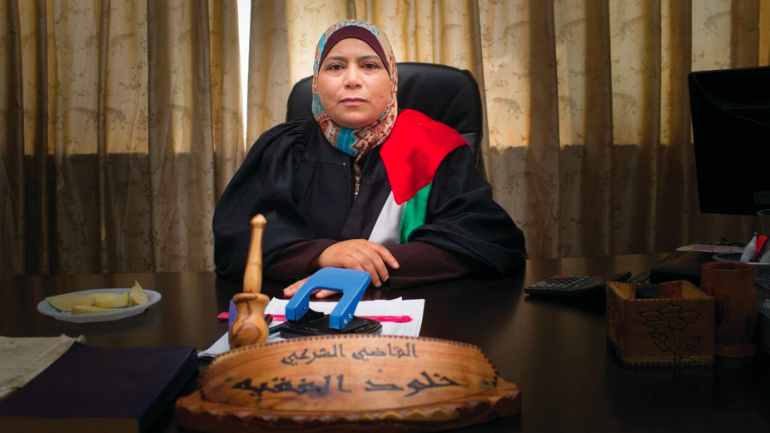
The religious Shari’a courts of Islam ban women from adjudicating domestic and family matters. Kholoud Al-Faqih, a criminal lawyer who has drawn the support of a progressive Sheik, challenges over 1,000 years of tradition with her appointment as the first woman judge to sit on a West Bank Palestinian Shari’a court. THE JUDGE follows Kholoud inside and outside the courtroom as she redefines how Shari’a law treats women despite attempts to marginalize and demote her.

SFF Selection Committee member Shelley Sackett caught up with Erika Cohn (SFF special screening IN FOOTBALL WE TRUST) ahead of the film's New England premiere on Sunday, March 25 at 4:50pm at the Peabody Essex Museum.

SS: How did you get into filmmaking?

EC: I grew up in Salt Lake City, UT and started attending the Sundance Film Festival at a young age, where I fell in love with independent film. I deeply felt the power of cinema and craved the feeling of being transported into different worlds/places/cultures for a couple of hours. I was 15 when I made my first film, mentored by a local youth media program in conjunction with the Sundance Institute. At the time, I was struggling with how to self-identify as a non-Mormon, coming from an interfaith family in a city where faith defines who a person is. Film became a catalyst for me to express my frustrations with socio-cultural-religious alienation and to heal intergenerational wounds. After this experience, I became committed to providing a platform for unheard voices to be heard and untold stories to be told.

It's a great privilege to be a storyteller, which comes with tremendous responsibility - which I do not take lightly, and I'm driven to using cinema to move audiences to a more just world.

SS:How did you get involved with this project?

EC: While I was on a shooting hiatus with my last film, IN FOOTBALL WE TRUST, I received a Rotary Ambassadorial Scholarship in Israel/Palestine. There I taught film, mentored local filmmakers, assisted NGOs launch media advocacy projects, and continued my post-graduate research in Islamic feminism at Hebrew University. One day, a dear friend and colleague invited me to attend a Shari’a law reform meeting in Ramallah.

I was welcomed into a large conference room filled with the images of Arafat throughout the years hanging in old picture frames, and seated at a table surrounded by men in tarbooshes (hats that judges and sheikhs wear). Then Judge Kholoud walked in and everyone stood to great her. I was immediately struck by her presence – her confidence – her command of the room. I wanted to know more. Who was this woman? What was her story?

Judge Kholoud and I were introduced at the end of the meeting and I was moved by her charisma and personal story. After spending her first years as an attorney representing women who were survivors of domestic violence, Kholoud felt she could best catalyze change in the Shari’a courts, where familial cases are adjudicated. She then turned to the Shari’a text to prove that women could be judges and began studying for the judicial exams. I remember asking her how she felt about the mistreatment of women under Shari’a…to which she responded, the problem isn’t with the Shari’a, it is with the interpretation (or rather misinterpretation).

Upon learning I was a filmmaker, Kholoud immediately expressed enthusiasm in making a film about her journey. She hoped that sharing her story would inspire other women and girls throughout the Muslim world to pursue leadership roles in their communities, despite cultural and/or traditional norms. Thus, THE JUDGE was born.

I immediately called mentor and Executive Producer, Geralyn Dreyfous to tell her about this encounter who encouraged me to pursue the project and was an invaluable producing partner throughout the journey.

SS:Why did you feel compelled to make this film? What about the story ignited a fire in your belly?

EC: I have always been fascinated with how law is interpreted – how power, economics and/or status can influence implementation. I am captivated by the intersection and tension between religion, culture and identity. I am drawn to narratives about strong women. Kholoud’s story stuck with me and I felt that her experiences might invoke a more nuanced understanding of Shari’a, challenge rapidly increasing global Islamophobia and highlight positive advancements for women by women in the Middle East, which are often uncovered or ignored by mainstream media.

SS:What have the reactions to the film by audiences?

EC: We screened the film at numerous film festivals around the world, where audiences have been fascinated with Kholoud's journey and inspired by her courage, in addition to being captivated by the verité courtroom scenes in an environment that most audiences viewers would never be privy too.

SS:What do you hope audiences take away from the film?

EC: Judge Kholoud’s resilience and determination greatly impacted our entire team and will encourage others around the world to persevere through adversity – in asserting legal rights, achieving gender justice and challenging cultural and traditional norms. I believe her story reflects a collective struggle for women’s control over their bodies, economic welfare, custodial rights, and marital status. I hope THE JUDGE leaves viewers with a greater insight into Shari’a law and strong imagery of powerful Muslim women, while illuminating some of the universal conflicts in the domestic life of Palestine.

SS: Has there been any reaction in Palestine?

EC: We hope to screen the film in Palestine soon.

SS: What is your next project?

EC: I'm currently in development with my first fiction feature and in production with feature-documentary, BELLY OF THE BEAST, which intimately chronicles the journey of women fighting reproductive injustice in their communities.

SS: Anything you'd like to add?

EC: After SFF, THE JUDGE will open theatrically in numerous cities across the U.S. including NYC, LA, San Francisco, Berkeley, Seattle, DC, Boston, Salt Lake City, Chicago and Detroit among others. Later this fall the film will be broadcast on PBS's "Independent Lens" series.

FILMMAKER SPOTLIGHT: Beth Cloutier, Director of LAST STAND AT DODGE

SFF program director Jeff Schmidt caught up with Beth Cloutier, director of LAST STAND AT DODGE ahead of her film's World Premiere at The Cabot on Friday night at 9:20pm.

JS: We're excited to host the World Premiere your film and present it as our inaugural North Shore Spotlight - how does it feel to bring LAST STAND AT DODGE home?

BC: Salem, MA and the North Shore are home to me. I grew up here so to make a film that takes place in the area and to bring it back to share with the community is an honor.

JS: As a filmmaker, do you think it's more of a challenge to tell a story in your own backyard or is it an advantage?

BC: There are challenges and advantages of telling a story from one’s community. The advantage is that people know you and are willing to open up and trust you to tell the story.  Relationships grow and deepen as the film making process ensues. This creates respect and trust between the filmmaker and those being filmed.

JS: How did you first connect with Fats Hammond and what compelled you to start filming?

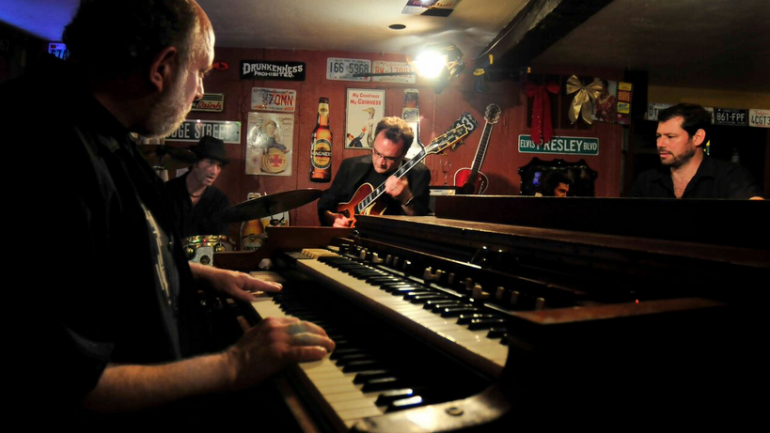
BC: I first connected with Fats Hammond back in the early 2000s. But it really began before that. When I was in high school, I would watch Marty Rowen play at the Red Room in Salem in the 1990s pre Fats Hammond days.  I went to college and when I returned I made sure to see Marty play. In the early 2000s, upon visiting home from living in NYC, I went to Dodge Street on a Tuesday night on the recommendation of a friend. I was immediately taken by the music and performance but what was just as special was the community surrounding Tuesday nights. All walks of life came to see Fats Hammond. College kids, veterans, bikers, professionals, 20 something’s to 80 year olds and folks from outside Salem would congregate to watch Fats play. After about an hour people were up dancing with one another. It didn’t matter who you were, everyone got along and had a good time together.

I moved to Marblehead for a year from 2009-2010 to help out with some family business. This was between my time living in NYC and LA. During that year I went to Dodge Street on Tuesday nights.  I was interested in filming artist portraits of Ken, Marty, Mike and Benny at first but as the year went on I realized that there was a story to tell.

JS: When Dodge Street closed and eventually was demolished, you were still editing the film.  Did it feel strange spending so much time looking at that footage, knowing that the place no longer existed?

BC: In the beginning I was sad to learn that Dodge Street Bar & Grill had closed. I had so many good memories there. But times changes and people move on.

JS: You've worked as director of photography for many documentaries over the years, how did it feel to sit in the director's seat this time around?

BC: Moving into the director’s chair was a bit of a challenge but one that I welcome.  As a DP I work closely with directors and producers on documentaries and at times I have to act as an interim director on shoots making sure to capture the vision of the production.

JS: Music seems to be a through-line in your life, I understand you've got a new project aimed at giving "other Fats Hammonds" more widespread visibility?

BC: Yes, I created a business and channel called Local Music Channel that focuses on highlighting local artists from the community and the venues that support them.  LAST STAND AT DODGE was the inspiration for the channel. Interacting with fans of the film throughout the country and internationally on social media, I learned that many communities were affected by the closing of local clubs leaving people without a place to see their favorite local musicians. I decided to create a channel thinking if I can show musicians and artists filmed high end with good audio in local venues from their community and post it online, that the good quality will attract more people to go out and support local musicians while showing the cool places they can view them.

JS: What do you hope the audience takes away from LAST STAND AT DODGE?

I hope the audience learns what their fellow local musicians go through in life to provide incredible entertainment for us in the community.  That we need to respect the art and not take it for granted. That these musicians work hard and should be paid well for their craft. Community benefits from that talent that lives within it. Music venues provide a place where community can come together to enjoy life and forget about their daily problems. It is important to support the venues that provide this.  If we lose these places and the music we lose part of our culture and the bonds and identity that are created by it.

FILMMAKER SPOTLIGHT: Ali Weinstein, Director of MERMAIDS

By Kereth Cowe-Spigai

MERMAIDS is my favorite kind of documentary--the kind that surprises me. When I sat down to watch this film, my interest level was fair to middling, and it was difficult to imagine connecting with the subject matter. But I did. In a pretty big way. That's the beauty of a great documentary--it manages to communicate essential truths through what can sometimes seem like obscure or unusual subject matter. The trick is to show that something small and unknown, something strange, is familiar, profound even, through the right lens. MERMAIDS certainly possesses this quality. One of the ways the film achieved this visually is through the stunning underwater photography. Director Ali Weinstein was kind enough to take the time to talk about her film with me, and the very first thing I wanted to know about were the breathtaking underwater shots.

KCS: Had you any experience with underwater photography prior to making this film?

AW: Thanks for the really nice words about the underwater cinematography in MERMAIDS. No, the only experience I’d had shooting underwater prior to this was while making a short film during film school. I got my friend to hold a GoPro while I (unsuccessfully) attempted some synchronized swimming moves that I used to be a lot better at in my youth. The footage turned out really moody but beautiful, partly because it was so low res and abstract.

KCS: Can you describe the process you went through with DP Catherine Lutes in crafting the underwater shots?

AW: Catherine is an incredible cinematographer, but she had never done any underwater work before, and we naively just threw her in the water hoping for the best. We bought an underwater housing and she had just a couple of hours to practice with it before we asked her to start shooting our subjects underwater. We were really lucky because as it turns out she’s an amazing swimmer and was able to get some beautiful shots right off the bat. I wanted our characters to be held up on screen in all their mermaid glory in the underwater shots especially – this was their chance during the film to fully transform into their alter egos, and have audiences view them as mermaids. So that was a goal that we aimed for – seeing their joy and their comfort underwater. We wanted these shots to be especially colourful and ethereal and majestic. We enlisted the help of a couple of other underwater cinematographers in addition to Catherine. We shot some of the film in Hawaii, and we knew of a couple who live there – Ali and Jim Ward – who are underwater photographers and had previously done a lot of work with mermaids. Because we were shooting in the open ocean and not in a controlled area like a pool, and because Ali and Jim are trained free divers who can stay underwater for extended periods of time, we decided to hire them to get some epic shots from deep in the water of Rachel swimming. So the intro and ending underwater shots of the film were both filmed by Ali and Jim. Surprisingly, no scuba diving gear was used during this film at all!

KCS: The narration over some of the underwater footage was such an effective way to connect the mermaid archetype to your characters' personal stories. How did you connect with Anastasia Phillips? Can you talk about the recording process a little bit? Was she able to see the footage before recording her lines?

AW: Thanks! While researching the film, I realized that there are literally mermaid myths from every corner of the world. I didn’t previously know the extent of the universality of this legend, but mermaids really are everywhere! It was important to me to acknowledge this in the film even though the movie is really about the lives of these five modern-day women. It was a bit tricky to figure out a way to incorporate some of the myths with our characters’ stories, and I worried that whatever we did would come off as cheesy. We found Anastasia just by reaching out to voice talent agents in Toronto who sent us clips of their actors reading our lines. We listened to hundreds of people, and Anastasia immediately stood out from the rest. Her voice was rich and beautiful and most of all just really natural, and I knew she could read these lines (which ran the risk of feeling too separate from the rest of the film) in a very organic way. Before working together, we talked on Skype once because she was in LA at the time, and then when she was back in Toronto we recorded all the lines in one two-hour session at a sound studio. She watched the underwater footage as she recorded the lines, but she hadn’t previously seen the film. I am so happy with the way it turned out; she’s a total pro.

KCS: One of the recurring themes across characters is the ephemeral, almost spiritual quality of being completely submerged in water--a sentiment you touched on in your Director's Notes as well. You focused on a few mermaids in particular, but did you find that to be the experience of the other mermaids you spoke to as well?

AW: For sure! I think one of the most common experiences we heard about from all the mermaids we met along the way is the sense of freedom they feel when they’re in their tails in the water. But I think that a lot of people can relate to that, whether you’re into mermaids or not. I think the lack of gravity, the quiet, and the sense of being totally alone when you’re submerged underwater all contribute to the sense of getting out of our everyday element, so to speak. Water is an element that symbolizes life and renewal to us, we come from it, are made of it, are baptized in it, and I think our basic human connection to it is part of what has allowed for mermaid myths to exist all over the world. A lot of people have related to this aspect of the film even if they never thought to put on a mermaid tail before.

KCS: Your subjects seem to all have a sense that there is something about their mermaid identity that clicks--it just makes sense--feels authentic to them as people. To me that points to something rather revolutionary and transcendent within a social structure that is heavily oriented toward a rigid gender binary. It seems to move the idea of an identity of the body in a direction that hasn't been explored in any mainstream context. Did you have a sense of this while you were getting to know these characters--that you were exploring something momentous, significant?

AW: When choosing who to focus on in the film, I remember telling Caitlin (the producer) that our main criteria should be finding people who were real mermaids. I didn’t exactly know what that meant at the time, and still don’t. But some of the people that we met clearly had such a strong connection to this part of their identity that they simply came off as mermaids, it didn’t seem like a character they were playing, and those were the people I wanted to hone in on. All of the women that we feature in the film have that authenticity in their mermaid identities. I didn’t think about it as a revolutionary idea, but certainly understanding this part of their identity was an important part of the film. And it was really significant to us that Julz wanted to take part in the film because within the mermaid community there are a lot of transgender mers, and we were really happy to be able to represent that experience in the film. Julz does a wonderful job of describing what wearing a tail does for her psychologically and how it allows her to feel more in sync with her body in the movie.

KCS: How have audiences received the film? Have you had any meaningful connections with viewers over their experience of the film?

AW: Overall, we’ve received very positive reactions so far, and it’s always such a nice feeling when an audience member lets us know how much they related to the characters in the film. One woman told us that seeing the strength and beauty of the women featured in our film made her feel strong and beautiful too, and that was probably the best compliment we could have gotten. Or when someone tells me that they only went to see the film because a friend dragged them but then they ended up loving it – that’s happened a few times too, which is always a really nice thing to hear. It’s not a topic that instantly appeals to everyone, so it’s nice to know that sometimes people will find an unexpected connection to our mermaids.

KCS:  You mentioned in your Director's Notes that you channeled some of your love of mermaids into synchronized swimming as a teenager. Is that something you ever go back to? Have you donned a fin?

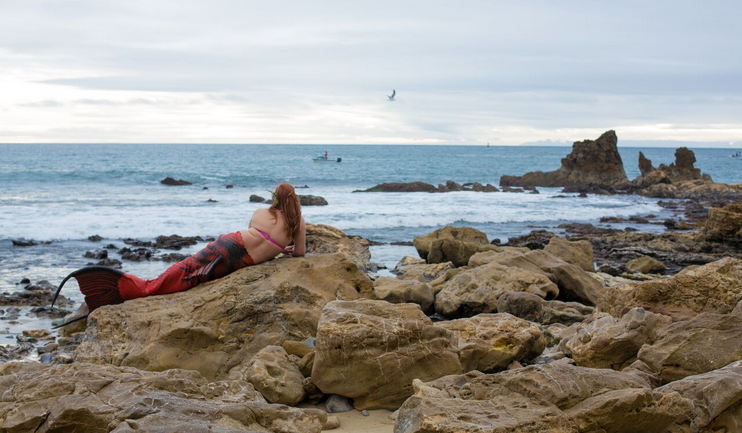
AW: Actually, I was inspired to get back in the water and try synchro again while shooting MERMAIDS! While interviewing Vicki (the 76-year-old mermaid who still swims at Weeki Wachee), she said, “can you imagine doing what you loved doing when you were just 17?” When I got home from that shoot, I joined a masters synchronized swimming team here in Toronto because that’s what I loved doing at 17. But on a less inspiring note, my filming schedule ended up being so rigorous that I couldn’t keep up with the team after a few months…so I had to stop. I do love swimming though, and it was such a pleasure to get to swim in so many pools, rivers, and oceans during the making of this film! Both Caitlin, my producer, and I tried on tails while we were filming, which was a lot of fun. We wore beautiful handmade silicon tails by Finfolk in the Hawaiian ocean, and it was surreal. They’re not easy to swim in, but once you get the hang of it, you do feel like an otherworldly creature.

KCS: Do you stay in touch with the subjects? Any updates you'd like to share?

AW: We do stay in touch with our mermaids from time to time. I’m happy to say that everyone seems to be doing really well! Vicki is still swimming at 78! Julz and Nicole are doing great and are now engaged. Rachel and her mom are working as hard as ever at Dive Bar and Mermaid and Mom. And Cookie and Ralph are also doing great. Ralph even tried on a tail not long ago, which he swore he’d never do.

Well that certainly speaks to the power of the fin--Cookie and Ralph as a pair of merfolk is a lovely image! Thanks again Ali for taking the time to discuss your film with us.

MERMAIDS screened on Saturday, March 24th at 2:40PM at CinemaSalem.
Ali Weinstein in attendance for a Q&A after the film.

FILMMAKER SPOTLIGHT: Eric Weiss and Bradley Berman, Directors of NAT BATES FOR MAYOR

NAT BATES FOR MAYOR is a straightforward, compelling portrayal of mayoral candidates vying for the vote in Richmond, CA. Directors Bradley Berman and Eric Weiss go in for the extensive, intensive coverage of the sparring city council, candidates pounding the pavement, and public figures outside of their local haunts, at times dreaming and seething. What results is an even portrayal of the people and the events that involve them as they unfold in the verité style.

The New England premiere of NAT BATES FOR MAYOR will take place on Saturday, March 24 at 5pm at CinemaSalem.  Both directors kindly responded to some lingering questions ahead of the screening via email with SFF Blog contributor Rebecca DeLucia.

RD: What is the purpose of showing this loud conflict? What challenges did this present in terms of storytelling? What is your relationship to the lurid details of a story as it unfolds?

EW: The atmosphere inside the city council meetings illustrated the conflict between the parties. It was a very contentious time in Richmond. Also, local politics is good theater. You can’t fake that kind of passion.  Our relationship to the details was somewhat detached. Some of the details we showed were vivid, yes, but it seemed to us that everyone stood by what they said. We weren’t trying to protect anyone or promote either side.

BB: The purpose of showing the craziness at Richmond City Council meetings is that it happened. There were two or more factions in conflict with one another. And unlike many other political environments, the leaders of this small city were not the least bit concerned about voicing their opposition in an over-the-top way. We didn’t have a “relationship” with the details. This is the way they behaved and our job was to show it. Most audiences find it captivating and humorous, which keeps them engaged in the story, which is a good narrative device.

RD: The people involved in the election that comprise the doc’s cast of characters are all forthcoming personalities; in fact, their professions require a kind of declarative default--making public statements, presenting a self for campaign circulation, etc. How did you deal with these factors in terms of researching and depicting subjects? What are some difficulties when balancing self-fashionings with more objective documentation?

EW: This is, first and foremost, a movie about people. We wanted to document the conflict between the parties rather than getting to some kind of declarative reality beyond the fact that one side wins and the other one loses. We learned a lot about the characters as the movie went on and we think that is reflected in the movie and passed on to the viewers.

BB: For this story, there was value in showing it as such (full stop). The Progressives believe that Nat Bates is a corporate stooge who is okay with pollution from the refinery. The African-American politicians believe the mostly white Progressives are outsiders, racist and don’t care about jobs or the well-being of the city’s long-time black residents.

RD: In this documentary, you show one party fighting an uphill epistemological battle regarding certain facts of campaign funding, political subversion, and near-sightedness, etc. while another relies less on facts and more on rhetoric, identity, and performative brio.  How does this make you more aware of your role as directors authenticating and disseminating facts? How would you say you participate in myth-making, or would you say this is an inevitable risk of the documentary medium? What are some strategies for avoiding it? Can you imagine subjects or scenarios in which it may prove helpful or informative to participate in this myth-making?

EW: We certainly were not aware that we were making any myths. Suggesting that we have the ability to do so is very flattering. That assumption may also imply that we had a larger agenda at play, or that we sided with one side rather than another. We are both from the area, but not from Richmond, so it gave us some distance. We were lucky that the story played out in front of us and we took the parts that supported that story. Our role was simply to let the events play out and to see what kind of story we had at the end. Happily, it worked out. Our goal was first in service to the story and the characters. A suggestion would be not to have any preconceived notions and consider the story first.

BB: We found both sides’ approaches interesting in their own way. Our role was simply to let the story play out and to see if we had a story at the end. Happily, it did. The different tactics they employed to get out the vote also distinguished the two sides. The styles, strategies, constituencies and issues were very different and interesting. The facts were important if they help move the story along. This is not a movie designed to promote a political agenda.

RD: Your verité, or fly-on-the-wall, style seems appropriate for a project already so packed with large, effusive personalities. Do you think your reserved role in conveying the story directs attention away from yourselves as shapers of this story? Do you think this impacts the way people read your work? What sort of questions are you usually asked about your work? Are they more about events you cover, or your creative process?

EW: We had no interest in being the movie, or making a movie about people making a movie. Since the movie is not a polemic, per se, removing ourselves allows the viewer to make up their own minds. Maybe that’s why people respond to it. We saw a shift occurring before our eyes and wanted to capture the end of an era in Richmond’s political culture before it ended. If the story says something about the sorry state of American politics, the Democratic party, or something bigger, that’s a bonus. People usually ask us why we made the film and how we got the access to the subjects.

BB: We are a lot less interesting than Nat Bates, Corky Booze, and many of the other people in the movie. Our job was to get out of the way and to focus on the story--not the filmmaking. People usually ask us why we bothered to take on this project. We found the people and their situation to be fascinating.