Filmmaker Spotlight: Cody Westman, Director of HELL OR CLEAN WATE

Shawn Bath is a former fisherman who once thought nothing of tossing garbage out his truck window. All that changed when diving in the harbors of his native Newfoundland and finding the ocean floor covered with tires, boat parts, nets and “disposable” plastics. Bath quits his day job and dedicates himself to the obsessive task of hauling out thousands of pounds of the rotting mess. He soon finds himself with less than $10 in his bank account, creditors calling daily and a stressed relationship with a supportive but concerned girlfriend. In the face of all this, Bath never loses hope in the possibility that one man might spark change in the world.

HELL OR CLEAN WATER can be streamed from anywhere in the United States during the virtual portion of Salem Film Fest which runs through Sunday, April 3. SFF Program Director Jeff Schmidt caught up with Director Cody Westman to speak about his film.

HELL OR CLEAN WATER Director Cody Westman

Jeff Schmidt: While you have an extensive production background, HELL OR CLEAN WATER is the first documentary feature you have directed. What motivated you to "dive" into a longer format production and was it your intention to find a story that delved into environmental subject matter?

Cody Westman: Although I make a living creating corporate and commercial material, I've been obsessed with film (and music) for decades, both documentary and narrative. After doing a few short films I knew I wanted to dive into a feature, but was just looking for the right story. When Shawn's story came on my radar I knew it would interesting and worth the two years of production to bring it to the screen.

JS: As we see at the beginning of the film, Shawn is in many ways flying under the radar as far as the public being fully aware of his clean up activities - how did you find Shawn and how difficult was it to convince him to let you film?

CW: It wasn't difficult to convince Shawn to let us tell his whole story as he initially contacted me. He wanted me to help bring his story to the public here in Newfoundland in a short video to raise awareness, but when I heard him say that he had 'removed 15,000 pounds of trash from the ocean by himself in a year' I knew that it would make for a good, larger story, the main theme being 'how hard will it be for this guy to get this off the ground'? I'm glad we stuck with it and Shawn put up with a film crew in his face for nearly 2 years because what he's doing is very inspiring and we can all learn from it.

JS: Were you surprised by the amount of discarded tires and trash that Shawn seemed to have a knack for finding? I think a lot of us don't fully realize the level of pollution in our waters since it's not in plain sight.

CW: We heard the phrase 'out of sight, out of mind' a lot while filming. Everyone we met knew that people used to throw garbage in the ocean, but since it's not clear water like in the Caribbean, you can't see it. When you get under to the dark and murky waters of literally every harbour here in NL you realize that it's everywhere. It's very disheartening. Of course there were many people that did not want to go on camera and some of the best bits we heard were off the record. Apparently some people in these communities would take their bags of garbage in the winter time and throw them out on the ice, a pile of trash just waiting to sink to the bottom as the ice melted. Can you imagine? I think that mindset has changed now but many people still don't think twice to throw their bottles and plastics from their boat overboard when there is no land in sight, no prying eyes.

JS: We seem to be living in what feels like an increasingly polarized society, which is frustrating and disheartening to many of us. Something I appreciated about your film is that it demonstrates that it is possible for people with different perspectives to actually work together to achieve a common goal. Can you talk about your experience as a filmmaker watching the different personal dynamics unfold between your "characters" and how it impacted your storytelling?

CW: Twillingate is a very small (and beautiful) little town in NL and the people who live and work there don't forget the past so easily. Many people blame IFAW and their activities for nearly shutting down the sealing industry and costing many families their livelihoods. Although we didn't feel unsafe at all, more than one person said we should be careful going to a restaurant with Sheryl from IFAW cause the anger is still fresh. The fact that Sheryl and Shawn put their differences aside for the good of the ocean was a very positive step. But as you can see in the film, as soon as the local government learned that IFAW was getting a grant to clean the ocean, they lobbied to have the money revoked. Once they found out that the infamous environmental organization wasn't coming here with crews from Ontario to clean NL waters and that all the money was going to Shawn and CHI they were ok with it. There is a deep divide around here, many Newfoundlanders blaming IFAW for the decline of their age old industry and certainly made for a unique dynamic!

JS: What do you hope viewers will take away from your film?

CW: I hope Shawn's story resonates as an example that one person can make a difference. Cleaning up small harbours in Newfoundland is a drop in the bucket regarding the waste and over-consumption problem we face in this world, but it's a start, and if every coastal community started their own Clean Harbours Initiative it would be a step in the right direction. We only have one Earth and we need to come together to take of her before it's too late.

HELL OR CLEAN WATER streams at Salem Film Fest through Sunday, April 3. Purchase tickets to the film here.

American Cinematographer Award at Salem Film Fest - Read Editor-in-Chief Stephen Pizzello's Comments

TIGRE GENTE

Every year, Stephen Pizzello, Editor-in-Chief of American Cinematographer graciously watches films from our lineup and selects Salem Film Fest's cinematography award. Below are his comments on the nominees and winner of this year's award.

All of this year’s nominees for the American Cinematographer Award alert viewers to tragic situations slowly devolving toward catastrophic loss — the erosion of natural environments, the destruction of animals that are nearly extinct, and sad circumstances that suppress the hopes and culture of an indigenous people.

LAST OF THE RIGHT WHALES

Last of the Right Whales, directed by Nadine Pequeneza and featuring cinematography by Mark Hammond and Stefan Randstrom, ponders the fate of a critically endangered species. Although right whales are no longer hunted for their oil, meat and bones, fewer than 400 now exist thanks to ship strikes and entanglements in fishing gear that can lead to painful, protracted deaths. Pequeneza’s documentary is an impassioned plea to save these magnificent sea creatures, who may be functionally extinct by 2040 unless human beings make a determined effort to save them.

Rarely sighted, right whales make for a challenging documentary subject, and filming them in their natural habitat requires extraordinary diligence and technical flexibility. Drones, floating camera rigs and other special pieces of equipment were deployed to produce spectacular footage of these elusive marine mammoths, but also wrenching visuals that detail their distress.

TIGRE GENTE

Tigre Gente, directed by Elizabeth Unger and shot by Edward Roqueta, documents the ongoing eradication of another threatened species, the jaguar, by focusing on efforts to thwart Bolivian poachers who illegally hunt the animals so they can sell their pelts, skulls and teeth. From its impressive opening shot onward, this compelling doc takes a very cinematic approach to its subject matter as it follows two main protagonists: the director of the Mididi National Park, who’s made it his life’s mission to protect the jaguar, and a Chinese environmentalist, whose conscience compels her to question her own culture’s complicity in the animal’s plight.

Their quest is framed like an investigative thriller, featuring dynamic landscape and wildlife cinematography interspersed with stunning aerial work, time-lapse photography, and undercover footage captured surreptitiously with hidden video cameras.

EXPOSURE

Exposure, directed by Holly Morris, chronicles an ambitious adventure that required two lead cinematographers (Kathryn Burrows ad Ingeborg Jakobsen) and six additional camerapeople to track 10 women from various countries as they attempt to make a 100-kilometer trek to the North Pole in 10 days. The intrepid team of explorers was assembled from a pool of nearly 1,000 women who answered a global call for applicants to join the perilous expedition, which raised funds over two years through sponsorships and crowdfunding. After convening for a pair of grueling training sessions, the team meets in the Arctic outpost of Svalbard, Norway to begin their trek — despite hazardous conditions made even more extreme by the fact that the very formation of sea ice is at an all-time low.

What results is an inspirational, life-affirming journey featuring scenic shots that capture both the glories and hardships of a physically grueling, emotionally draining quest — one that requires the women to trudge through a frozen landscape of constantly shifting ice that poses a formidable logistical challenge.

SCENES FROM THE GLITTERING WORLD

Scenes from the Glittering World, directed and shot by Jared Jakins, surveys the emotional and physical landscapes occupied by three indigenous youths struggling with the alienating realities of their daily lives in a remote corner of Navajo Nation. From its creative opening shots, which “reveal” the documentary’s settings through colored cloths fluttering over the camera lens, Glittering World leads viewers through a range of settings and emotions captured with an abundance of local flavor and visual flair. Witty compositions frame some of the lighter moments on the reservation, and stark but beautifully composed landscapes effectively capture the bleak tone of the young protagonists’ lives.

The cumulative effect of these affecting techniques generates a great deal of empathy for the people portrayed onscreen as they attempt to connect with each other, overcome their individual or family issues, and come to grips with tribal traditions that may fade away unless they and other members of their generation actively strive to keep them alive. As the various narrative strands are woven together, the documentary’s fine details produce an authentic emotional kick, and viewers will surely find themselves rooting for these kids to pull through and succeed.

All of these projects qualify as award-worthy docs, making it a challenge to spotlight just one of them for the American Cinematographer Award. In the end, my decision was only made after meticulously assessing the sheer number of exceptionally photographed moments — captured in a wide range of conditions and circumstances — that each entry offered.

TIGRE GENTE

Ultimately, I felt that the truly cinematic qualities of Tigre Gente elevated it to the top spot in a very competitive field, but all of the filmmakers should feel honored to have their superb work recognized and showcased by the festival.

Stephen Pizzello - Editor-in-Chief, American Cinematographer

All of these films are available for streaming with Salem Film Fest through Sunday, April 3 - Watch them here.

Filmmakers Spotlight: Co-Directors Clementine Malpas, Sam French and Producer Leslie Knott, WITH THIS BREATH I FLY

WITH THIS BREATH I FLY - Gulnaz and her daughter

At the height of the international occupation of Afghanistan, two women—Gulnaz, raped and impregnated by her uncle, and Farida, on the run from an abusive husband—are imprisoned on charges of “moral crimes” by an Afghan justice system that is supported by billions of dollars of aid money from the European Union. WITH THIS BREATH I FLY follows these two courageous women fighting for their freedom against a patriarchal Afghan society, while exposing the complicity of the European Union in censoring their voices, and how the international press—and the documentary itself—forever alters the course of their lives.

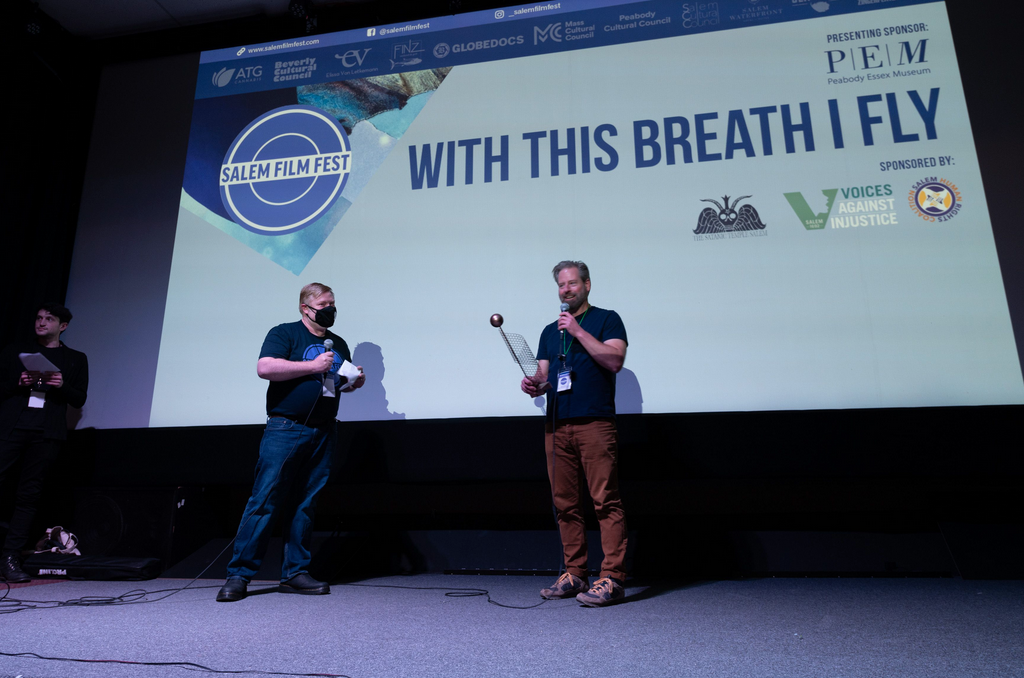
WITH THIS BREATH I FLY Co-Director Sam French accepts the Special Jury Award at SFF 2022 - Photo by Shane’s Maine Photography

WITH THIS BREATH I FLY is the winner of the Special Jury Award at Salem Film Fest 2022. The film screened in-person at Salem Film Fest and is available for streaming anywhere in the United States during the virtual portion of our festival which runs through Sunday, April 3.

Salem Film Fest is happy to be collaborating with Marblehead High School on some of this year’s Blog Posts and we are grateful to MHS Teacher Connor Ryan who has been working with his students in exploring this year’s festival.

This interview was written by Zoe, Summer, Caitlin, Cate, Arielle, Martha, Madeleine, Yasen, Celine, Lilly, Lia, Lauren, Griffen, and Griffin -- Marblehead High School's groundbreaking G block AP Language and Composition class.

Marblehead High School: How did you find this project? 

Leslie Knott: I had done a photo project in the women’s prison in Kabul for Grazia magazine and saw firsthand the desperate situation for women being held there for moral crimes. When Clem approached me with this idea for a film, I knew that this was an underreported and important story to tell.

MHS: How did you find these women to interview?

Clementine Malpas: We were given access to the prisons through the EU. We were free to walk around the prisons and talk to anyone who was interested in telling their story. Lots of women wanted to talk to us, and a few, including Gulnaz and Farida, were happy to be filmed.

MHS: Were there other women who weren’t in the documentary whose stories stood out to you? 

Producer Leslie Knott (L) and co-Director Clementine Malpas (R) - Courtesy Tiger Nest Films

CM: Yes, lots of women had really upsetting stories. We followed the case of a sixteen-year-old girl who was kidnapped from Kabul and taken to Parwan, raped and subsequently arrested for adultery. Unfortunately, we couldn’t include her in the final edit.

MHS: How did you initially begin working with/for the European Union?

CM: We were approached to apply for funding from the EU to make a film about women’s rights. We won the contract and pitched the story of moral crimes to them. They agreed on the story and helped with access to the prisons. Without them we would never have had the access.

MHS: How did the scope of the project change as your relationship with the EU changed?

CM: We followed the stories of the women for much longer than we would have, had the EU signed off on the film after the first edit. We would never have got the press coverage without the EU pulling their consent. It might have taken longer for Gulnaz to be freed. The film would have ended with Gulnaz and Farida still in prison. 

Sam French: We were prohibited from filming for a year after the EU told us we had to delete all our footage and blocked access to the prisons. But after the press started covering the story, it brought attention to the matter and helped pressure President Karzai to issue a Presidential pardon for Gulnaz. Because of the international attention on their decision to block the film, the EU ended up assigning full copyright of the film to us and we were able to continue filming. Because this behind-the-scenes drama directly affected our subjects, we felt like we had to include this storyline in the film. In doing so, the film raises larger questions of power and representation – who decides whose voices are heard, what role does the media have in exposing injustice and shaping the narrative, and what responsibility does the international community have to protect women’s rights in a country like Afghanistan.

MHS: How did you account for cultural differences while filming?

CM: Once the women had consented to being on camera, we made sure their families were also happy for them to be in the film. Families are the biggest threat to women when they came out of prison. As we were a female camera crew, we had a lot of freedom with the women and their families at home.

MHS: Did you have to make any accommodations? 

SF: We were very upfront about the filmmaking process to the women throughout the course of production, and clearly explained what we were trying to do in order for them to give informed consent.

MHS: Were there any special considerations?

SF: We had to respect the cultural separation of men and women in society, so we had to be very careful to have an all women crew when we were filming intimate verité scenes and interviews with the women.

WITH THIS BREATH I FLY - Gulnaz and the Uncle who raped her

MHS: Without giving anything away: were there any particular challenges in filming?

CM: Most importantly, we made sure to take into careful consideration the security of the women and to make sure that everyone was happy to be on camera. 

 Although we had very good access to the prisons at the start of filming, as time went on it became harder and harder to get in. Farida’s prison was a two and a half hour drive from Kabul, and we were often turned away when we arrived, or we had to spend hours drinking tea with the guards to be allowed in, or we were sent away and asked to come back another day. 

 It was even harder to get access to the male prisons, the courts and the women’s shelter. Often, we thought we had permission only to be turned away when we arrived. 

WITH THIS BREATH I FLY - Kabul

MHS: Were there any particular challenges in bringing this project to market?

SF: Accessing funding for a project like this is a challenge. After the dispute with the EU, we ran out of money, so we launched two crowdfunding campaigns over the course of a few years to raise enough money to finish the film.

MHS: We understand that your website is accepting donations for Women for Afghan Women. How is that going so far and how can people help?

SF: We have a link on our website where people can donate directly to Women for Afghan Women, an organization that helps women accused of moral crimes, and we are donating a portion of our proceeds to them as well.

WITH THIS BREATH I FLY streams at Salem Film Fest Monday, March 28 - Sunday, April 3. Purchase tickets to the film here.

Filmmaker Spotlight: Laura Lamanda, Director of LOST AND FOUND IN PARIS

LOST AND FOUND IN PARIS - Courtesy of Make Studio

All day long, people come to the reception desk at the Lost and Found Office in Paris. It's a never-ending flow. They want to retrieve their belongings and they're in a hurry. But finding what has been lost is not an easy task. It requires time. The time it takes to wait for their turn and fill out paperwork. Time to explain what has been lost. Time to find the item in the warehouse and send it back up the freight elevator. LOST AND FOUND IN PARIS takes place entirely inside this fascinating space, and takes the time to tell the stories of both those at a loss and those in charge of returning the objects we carry, cherish and misplace.

LOST AND FOUND IN PARIS screened in-person at Salem Film Fest and is available for streaming anywhere in the United States during the virtual portion of our festival which runs through Sunday, April 3.

Salem Film Fest is happy to be collaborating with Marblehead High School on some of this year’s Blog Posts and we are grateful to MHS Teacher Connor Ryan who has been working with his students in exploring this year’s festival.

This interview with Director Laura Lamanda was written by Zoe, Summer, Caitlin, Cate, Arielle, Martha, Madeleine, Yasen, Celine, Lilly, Lia, Lauren, Griffen, and Griffin -- Marblehead High School's grandest G block AP Language and Composition class.

Laura Lamanda

Marblehead High School: What inspired the film?

Laura Lamanda: Several summers ago everything was apparently going smoothly, when suddenly my things started getting lost. Everything: keys, books, identity cards, papers. My days were littered with small moments of mourning. And then, amid this uninterrupted stream of losses, the most serious incident occurred: I lost my laptop. When I found it again, several weeks later, at the Lost and Found Service, I was awestruck: strangers who owed me nothing had looked after me.

MHS: How did you choose your subjects?

LL: At the Lost and Found Service, the social mix of users is obvious. The loss concerns everyone, it does not discriminate. At the service counters, users follow one another at a steady pace and some of them only stay a few minutes before disappearing. This constraint forced me to be quick, to make choices very quickly.

LOST AND FOUND IN PARIS - Courtesy of Make Studio

MHS: Once chosen, how did you approach your subjects?

LL: I approached the users when I could read a strong emotion on their faces, when I had the feeling that something crucial was happening for them. My eyes were drawn to an almost solemn concentration when filling out the loss declaration, to agitated movements, or to strong apprehension during the exchanges with the agents.

MHS: Could you please discuss your choices regarding sound for this project?

LL: Since the Lost and Found is a very noisy place, we had to find an appropriate set up/technical solution. I wanted close and intimate voices, I wanted to isolate the noise of the objects handled by the agents of the service or by their owners. With Amaury Arboun, the sound engineer, we did some very precise location scouting and sound tests. In addition to the boom, we placed several microphones in the department in places where I knew we would be filming.

LOST AND FOUND IN PARIS - Courtesy of Make Studio

MHS: How did you create your voiceovers?

LL: When possible, we recorded the voice-overs in a small unoccupied room in the ward. I tried to create a quiet, protected environment, a cocoon in which the people being filmed could safely confide their words and vulnerability to us. With Marta Billingsley, the sound editor, we worked a lot on the sound rhythm of the film. Realistic soundscapes alternate with more muted and rarefied ones, such as during the voice-overs or during certain moments of fluctuation.

LOST AND FOUND IN PARIS - Courtesy of Make Studio

MHS: The film spends a lot of time focusing on the specifics of the Lost and Found Office. What was so intriguing about this location?

LL: When I went to find my computer, I discovered Rue des Morillons, this place devoted to loss. I loved spending time in the hall with its big windows and sturdy old furniture, where a crowd of bereft losers had wound up before me. I no longer wanted to leave this place. I wanted to stay there, surrounded by the others and their stories. I was intent on filming them.

LOST AND FOUND IN PARIS streams at Salem Film Fest Monday, March 28 - Sunday, April 3. Purchase tickets to the film here.

Filmmaker Spotlight: Diane Tsai, Director of BE OUR GUEST

The O’Leary Family - Courtesy of TIME Studios

In small-town New Hampshire, 8-year-old Ronan O’Leary and his family have made a commitment of radical generosity: welcoming strangers into their home and guiding them through their recovery from addiction. The guests share meals with the family and sometimes even bedrooms with the O’Leary children. This is the only life Ronan and his three older sisters have ever known. Every year, their mom asks them to choose whether or not to continue: “Are you willing to give up a year of your life, so that someone can have the rest of their life?” As the children enter adolescence, both the family and their guests are faced with difficult decisions about community, independence, and the real nature of altruism.

Salem Film Fest screening - Courtesy of Bobbie Bush Photography

BE OUR GUEST screened in-person at Salem Film Fest and is available for streaming anywhere in the United States during the virtual portion of our festival which runs through Sunday, April 3.

Salem Film Fest is happy to be collaborating with Marblehead High School on some of this year’s Blog Posts and we are grateful to MHS Teacher Connor Ryan who has been working with his students in exploring this year’s festival.

This interview with BE OUR GUEST Director Diane Tsai was written by Zoe, Summer, Caitlin, Cate, Arielle, Martha, Madeleine, Yasen, Celine, Lilly, Lia, Lauren, Griffen, and Griffin -- Marblehead High School's greatest G block AP Language and Composition class.

Diane Tsai - Courtesy of TIME Studios

Marblehead High School: How did you find the O'Learys? Were they initially interested? What were your initial hopes and concerns for the project?

Diane Tsai: I first met the O’Learys while reporting on a short video for TIME’s multimedia project on the opioid crisis (Editors note: Diane Tsai is a Senior Producer at TIME, a global news multimedia brand previously known to many when it published content as TIME Magazine). While observing their home, I was struck by how the O’Learys defied all my initial expectations. On that first trip, I surprised myself by immediately asking Lydia if she would be open to me coming back to continue filming. She said yes, amused that I found so many aspects of their lives worth documenting, because to them, it was just normal, everyday life.

My initial hopes were to simply convey what life was like in that house, because I felt that words wouldn’t be able to do it justice—I wanted others to be able to witness it for themselves. And it was apparent to me that the O’Learys had the potential to make a huge impact on the lives of the people who were living in their home, like Jenn, and I wanted to be able to watch how it unfolded. Were they naive in their ambitions, or were they onto something?

MHS: How did you make decisions about which aspects of peoples' lives to include or exclude? Were there scenes or interactions you omitted, and if so, how did you make those decisions?

DT: It was incredibly difficult to decide what to include and what to exclude. That’s the real challenge of editing, but it felt magnified when the footage spanned years and followed so many characters. We wanted to be able to share parts of everyone’s experiences, especially those who were so generous with their stories at such a difficult time in their lives. But it simply wasn’t possible, and got very confusing when we started introducing too many characters. Ultimately, in terms of the guests in the home, we wanted to depict individuals who could represent the range of journeys we witnessed. Jenn was always a clear main character, because she had such concrete goals, which she accomplished so gracefully. And Rich was representative of the people who passed through the O’Leary home who didn’t always see eye-to-eye with Jim and Lydia, and whose recovery story wasn’t a linear path.

BE OUR GUEST - Courtesy of TIME Studios

MHS: Do you think being filmed changed how the family and their guests interacted with one another? Was it difficult to get everyone's natural reactions as well as record everyone in the house interacting normally since they knew the camera was on them? How do you think the presence of the camera affected the day-to-day lives of the characters?

DT: I was very conscious of how the presence of my camera might affect the dynamics of the house, but it’s always surprising how easily people can adapt. They quickly became used to me hanging out around the house with a camera in hand, and I rarely felt that people weren’t being genuine. The few times I did get that sense, I would typically stop filming, because I think it’s very apparent onscreen when people are acting unnaturally for the camera.

MHS: How often and for how long did you film?

DT: The film spans more than three years, and I would try to visit once a month or once every two months, staying for a few days at a time. Once covid hit, it became difficult for me to travel, so our co-producer and cinematographer Jon Gourlay, who is based locally, was able to drop in for the day as needed.

Ronan - Courtesy of TIME Studios

MHS: A large part of the documentary focuses on Jennifer's journey. Is that something you, as a filmmaker, tried to anticipate? Similarly, did you anticipate that Ronan would be the dominant protagonist? How do you make those decisions?

DT: Very early on, I was struck by Jenn’s openness when talking about her struggle with addiction and admired her determination to reunite her family. The fact that Jenn found a home with the O’Learys when she was 7 months pregnant with nowhere else to go was such a remarkable story, I knew we had to keep following her journey.

With Ronan, it was a little less intentional at first, but came through in the initial footage of the house, even when I wasn’t sure who to focus on. I had always been intrigued by all four of the O’Leary children and their unconventional upbringing. While each family member has their moment in the film, Ronan began to stand out as the youngest child and only boy, who was just beginning to find his voice.

MHS: Do you keep in touch with the O'Learys?

DT: Yes, I love hearing updates on their ongoing home renovations, and am always curious to know who is currently at the house.

BE OUR GUEST streams at Salem Film Fest Monday, March 28 - Sunday, April 3. Purchase tickets to the film here.